


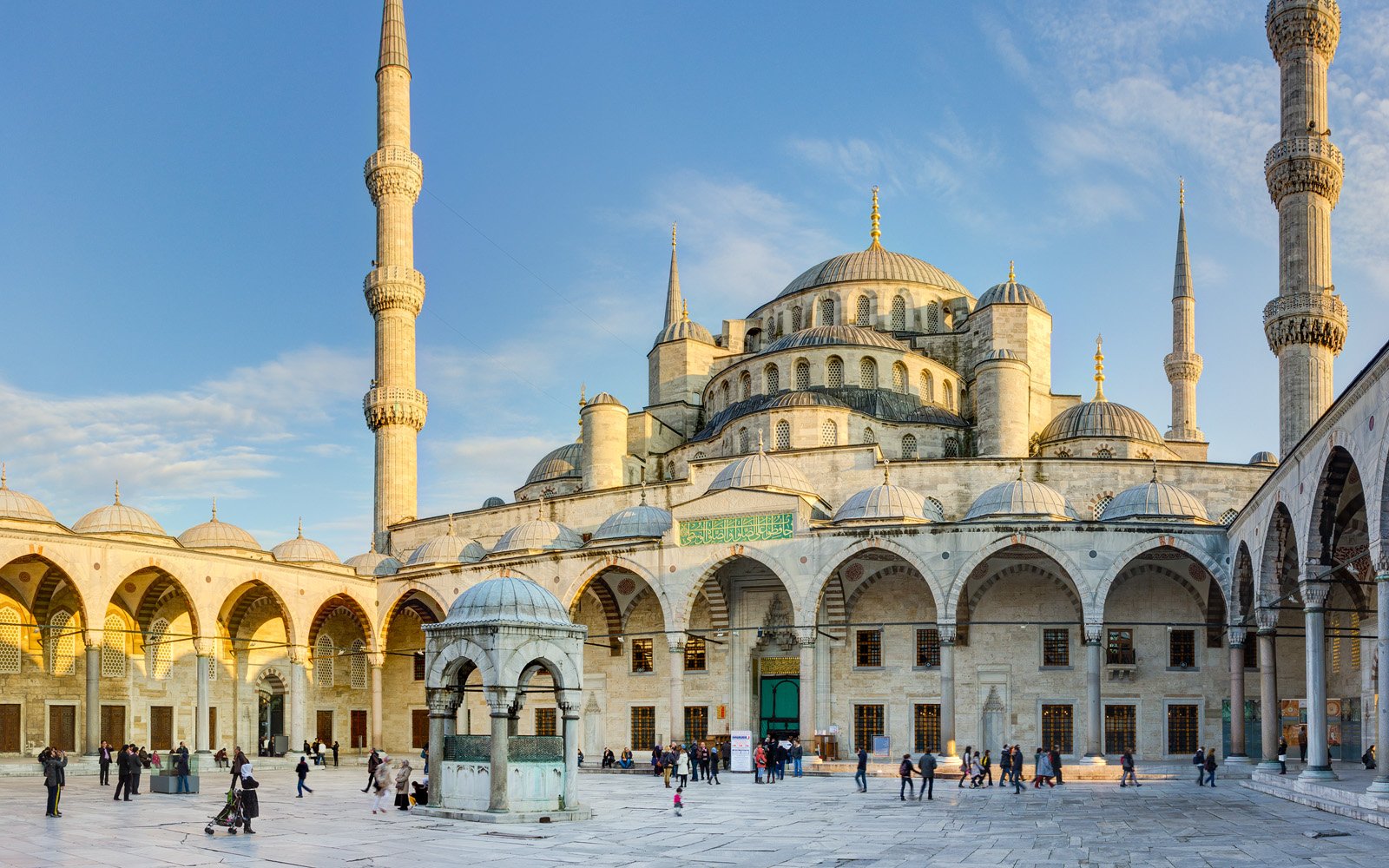
The Sultanahmet Mosque, known worldwide as the Blue Mosque, is not only one of Istanbul’s most photographed landmarks — it is a carefully engineered architectural statement of imperial power, faith, and artistic ambition. Built between 1609 and 1617 under Ahmed I, the mosque was designed to rival the nearby Hagia Sophia, both spiritually and architecturally. Let’s explore the structure in detail — and the stories hidden within its stones.
The Architectural Plan: A Dialogue with Hagia Sophia
The mosque was designed by Sedefkâr Mehmed Ağa, a student of Mimar Sinan. His challenge was immense: how do you surpass Hagia Sophia without directly copying it?
The Central Dome System
- Height: Approximately 43 meters
- Diameter: About 23.5 meters
- Supported by four colossal piers (often called “elephant feet”)
Unlike Hagia Sophia’s more dramatic structural tension, Sultanahmet Mosque uses a cascading system of semi-domes. This creates a visual pyramid effect — a sense of controlled harmony rather than raw structural daring.
The weight distribution is carefully calculated:
- The main dome rests on pendentives.
- Semi-domes absorb lateral pressure.
- Buttresses are partially hidden within the outer walls to maintain aesthetic elegance.
This is classical Ottoman engineering refined to its peak.
The Six Minarets: The Famous Controversy
One of the mosque’s most talked-about features is its six minarets. At the time of its construction, only the Sacred Mosque in Mecca had six minarets.
According to popular legend, Sultan Ahmed asked for “altın minareler” (gold minarets). The architect allegedly misunderstood it as “altı minare” (six minarets). Whether true or not, controversy followed.
To resolve the issue, a seventh minaret was later added to the Sacred Mosque in Mecca — preserving its supremacy.
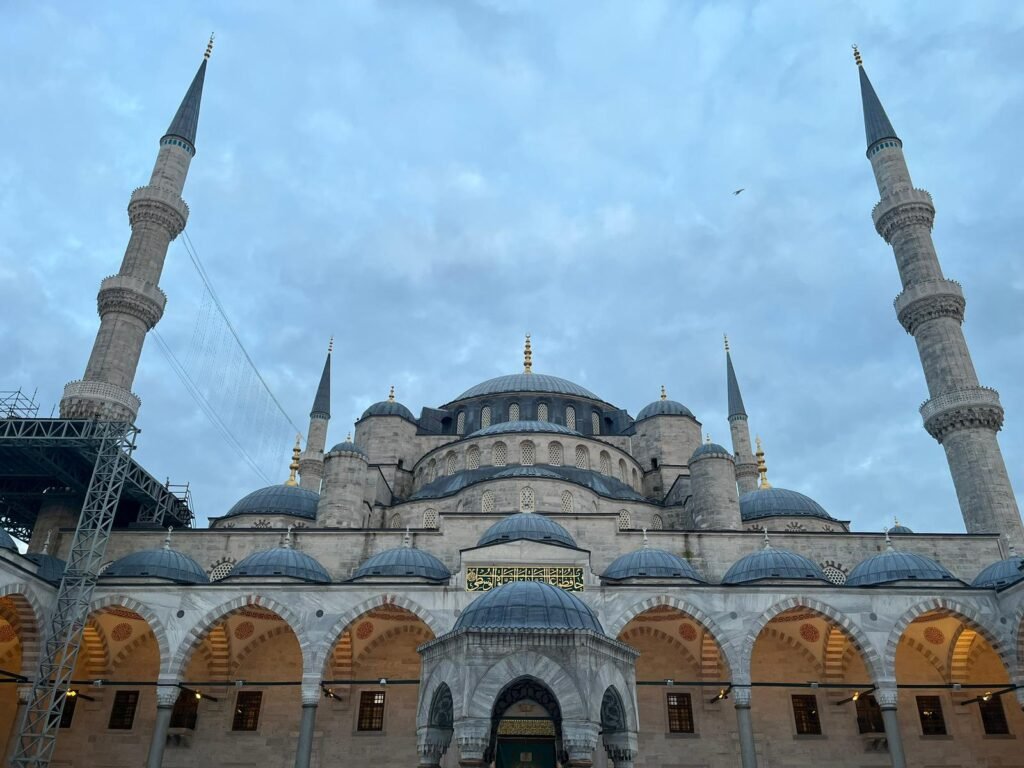
While this story is debated by historians, it remains one of the most repeated anecdotes about the mosque.
The Courtyard (Avlu): Imperial Scale
The mosque’s courtyard is almost equal in size to the prayer hall — a hallmark of classical Ottoman imperial mosques.
Features include:
- A monumental ablution fountain (şadırvan) at the center
- Arcaded porticos with small domes
- Marble flooring with geometric symmetry
The courtyard functions as a transitional space — preparing visitors physically and spiritually before entering the sacred interior.
The Interior: Light, Tiles & Symbolism
The İznik Tiles
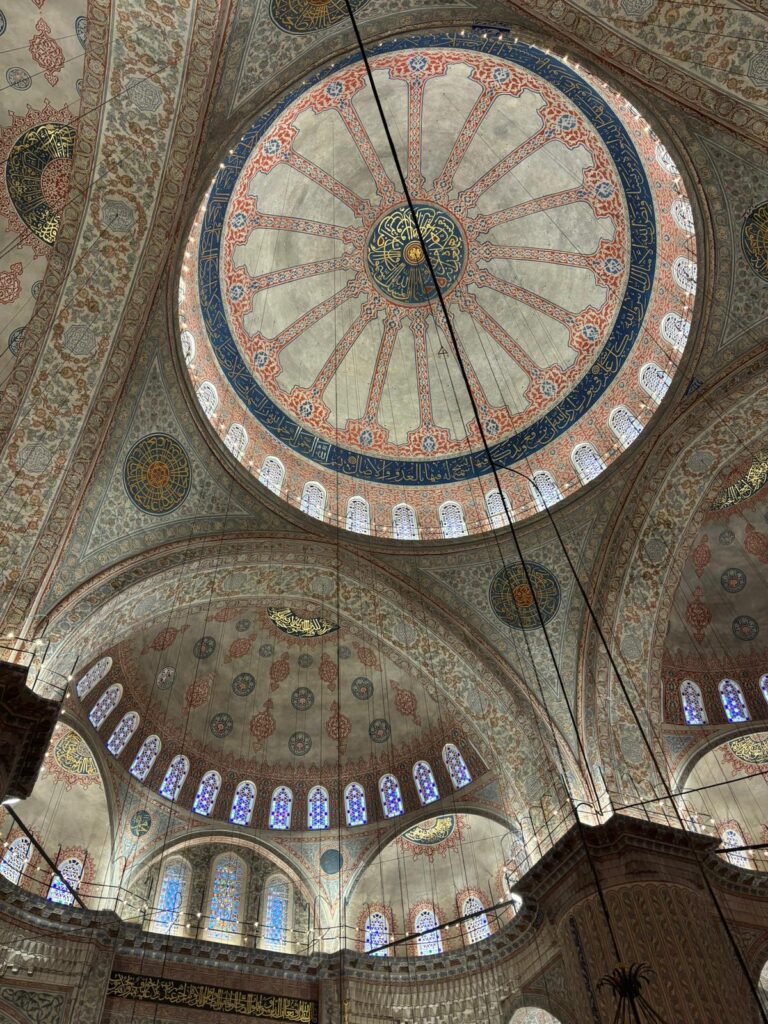
More than 20,000 hand-painted tiles decorate the interior. Produced in İznik, these tiles feature:
- Tulips (symbol of divine perfection)
- Carnations
- Roses
- Cypress trees
Interestingly, toward the end of construction, the quality of tiles declined slightly due to economic strain — a subtle reflection of the empire’s shifting fortunes.
The dominant blue tones are what gave the mosque its European nickname: “The Blue Mosque.”
The Light System
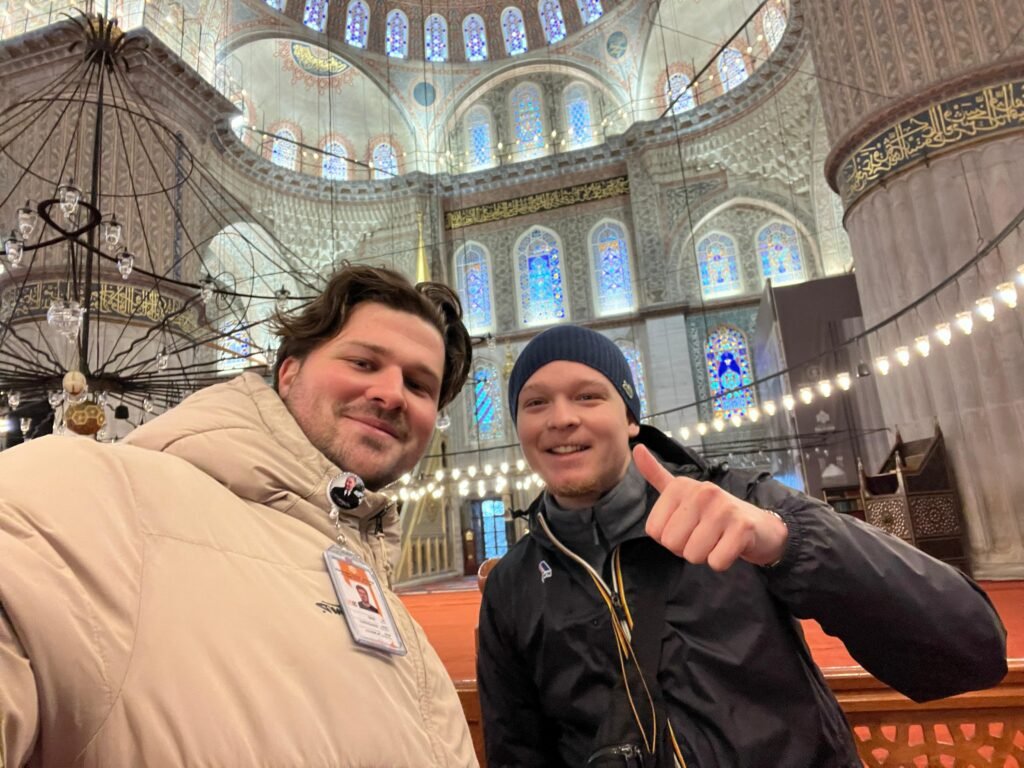
The mosque originally had over 200 stained-glass windows (some later restored). Combined with hanging chandeliers (once decorated with ostrich eggs to prevent spider webs), the lighting creates a soft, diffused atmosphere.
The ostrich egg detail is not symbolic — it was practical. It was believed to repel spiders and prevent cobweb formation.
The Mihrab, Minbar & Royal Loge
- Mihrab: Carved marble niche marking the direction of Mecca.
- Minbar: Slender marble pulpit for Friday sermons.
- Hünkâr Mahfili (Royal Loge): A private elevated space where the sultan could pray securely.
The royal loge connects symbolically to the nearby Topkapı Palace, reinforcing the relationship between political authority and religious legitimacy.
The Sultan’s Tomb: A Quiet Epilogue
Sultan Ahmed I died at only 27 years old, just one year after the mosque’s completion. He is buried in a türbe (mausoleum) adjacent to the mosque complex.
Unlike some Ottoman rulers who died on campaign, Ahmed’s legacy became permanently tied to this architectural monument — his greatest political and spiritual statement.
Structural Engineering Details (Often Overlooked)
For a more technical understanding:
- The foundation rests on compacted layers suitable for Istanbul’s seismic activity.
- The dome system distributes vertical loads downward rather than outward (unlike Hagia Sophia’s earlier model).
- Massive exterior buttresses stabilize the structure, but are cleverly integrated to preserve aesthetics.
- Iron chains were embedded within certain masonry sections for reinforcement.
Despite multiple earthquakes over four centuries, the mosque remains structurally sound — a testament to Ottoman engineering precision.
Symbolism & Political Meaning
The mosque was built at a time when the Ottoman Empire had recently signed the Treaty of Zsitvatorok (1606), which symbolically challenged Ottoman supremacy over the Habsburgs.
By constructing a grand imperial mosque directly facing Hagia Sophia, Sultan Ahmed I was making a visual statement:
- Islam stands confidently before Byzantine legacy.
- The Ottoman dynasty claims continuity over Constantinople.
- Architecture becomes political theology.
This positioning creates one of the most powerful urban dialogues in the world.
A Living Monument
Unlike many historical structures, Sultanahmet Mosque remains an active place of worship. The sound of the call to prayer echoing between it and Hagia Sophia continues a rhythm that has shaped this skyline for centuries.
It is not merely a monument.
It is architecture still breathing.
The Story Behind the Turquoise Color
There is a beautiful cultural story connected to the turquoise tone associated with the Sultanahmet Mosque.
The word “turquoise” actually comes from the French term pierre turquoise, meaning “Turkish stone.” In medieval Europe, a distinctive blue-green gemstone was introduced through Anatolian and Ottoman trade routes. Europeans believed the stone came from Turkish lands (even though its original mines were often in Persia), so they named the color after the Turks.
By the 17th century, this blue-green tone had become strongly associated in Europe with the Ottoman world — its textiles, ceramics, and decorative arts. When Western travelers entered the mosque and encountered its cool, luminous interior, they described it using the color they already linked to the Ottoman Empire: blue. Over time, this simplified description evolved into the popular name “Blue Mosque.”
So the story of turquoise is not just about pigment — it is about perception and cultural exchange. A color that Europe named after the Turks became one of the defining impressions of an Ottoman imperial mosque. In a way, the Sultanahmet Mosque carries a color identity that reflects centuries of trade, language, and artistic dialogue between East and West.
Why This Structure Matters Today
For architects, it represents the maturity of classical Ottoman design.
For historians, it reflects imperial anxiety and ambition.
For visitors, it offers a multi-layered experience — visual, spiritual, and political.
In Sultanahmet, stone becomes ideology.
Tiles become poetry.
Domes become statements of eternity.
Get in Touch – Discover the Sultanahmet Mosque with Us
Ready to explore the timeless beauty of the Sultanahmet Mosque? Let us guide you through its majestic domes, elegant minarets, and the stories hidden within its famous blue İznik tiles.
Whether you are planning a private Istanbul tour, a historical walking experience through the Old City, or a customized cultural itinerary, our licensed guides are here to provide you with an in-depth and engaging visit to one of the world’s most iconic landmarks.
Contact us today to:
- Book a private or small-group tour
- Create a tailor-made Istanbul itinerary
- Combine the mosque visit with Hagia Sophia, Hippodrome, and Topkapı Palace
- Receive detailed information about availability and pricing
We look forward to welcoming you to Istanbul and sharing the spirit, history, and architectural brilliance of the Sultanahmet Mosque with you.
Get in touch now and let your journey begin.
Tagged with :