


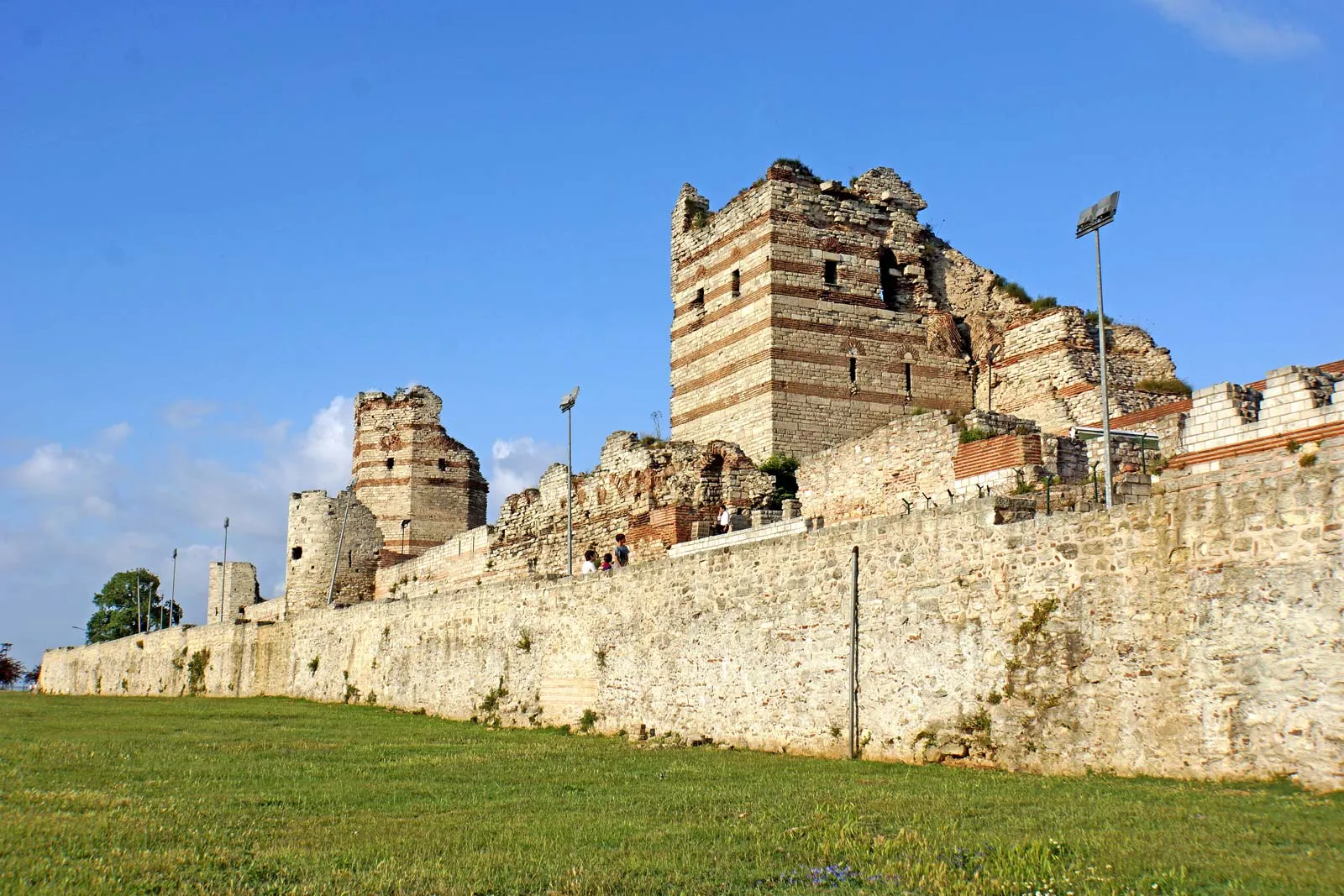
For more than a thousand years, one structure defined the fate of an empire. Not a palace. Not a church. Not an army. But a wall. Before it became Ottoman Istanbul, before it was even fully “Byzantine” Constantinople was a Roman capital protected by the most sophisticated urban fortification system of the ancient world. The walls were not built in a single phase — they evolved across centuries, responding to political crises, military disasters, and imperial ambition.
To understand why Constantinople survived when Rome fell, we must examine its Roman walls — from Severus to Constantine, and ultimately to the masterpiece of Theodosius II.
From Punishment to Reconstruction: The Severan Walls (3rd Century)
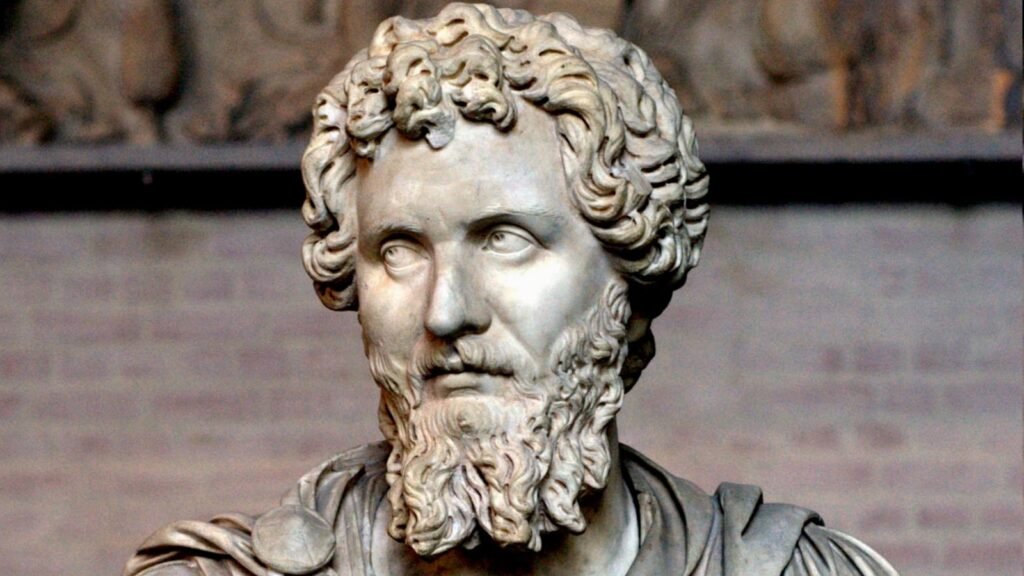
In 196 CE, during a Roman civil war, Byzantium backed the losing emperor. When Septimius Severus emerged victorious, he besieged the city, destroyed its fortifications, and dismantled its autonomy.
But Severus quickly realized the strategic value of the site controlling the Bosphorus strait. He rebuilt the city and constructed a new defensive wall farther west than the original Greek circuit.
This early Roman wall:
- Was a single defensive curtain
- Included towers at regular intervals
- Protected a growing urban core with a Hippodrome and baths
It marked the transition of Byzantium from Greek colony to Roman stronghold.
A New Rome: The Constantinian Expansion (4th Century)
Everything changed in 324 CE.
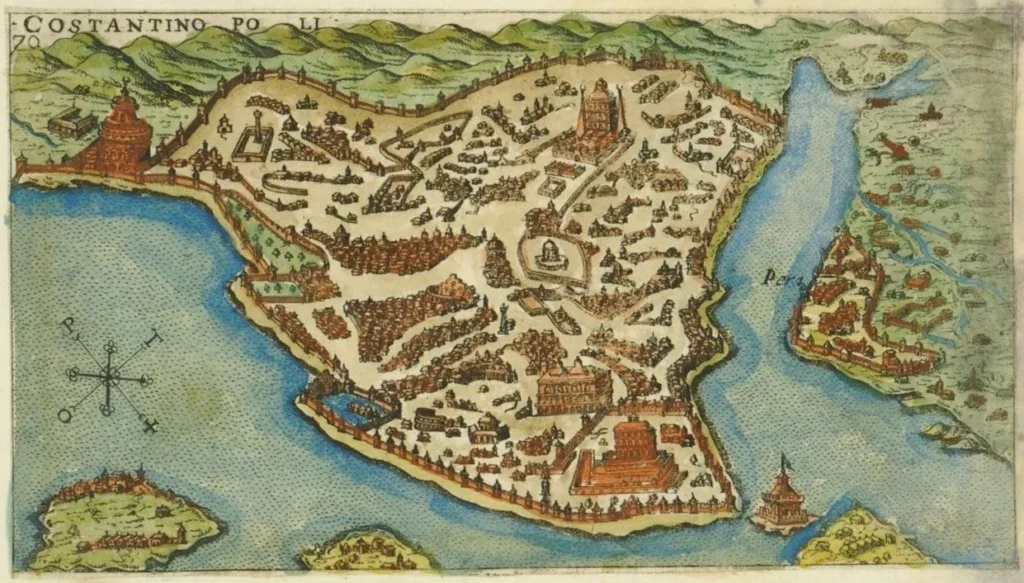
After defeating Licinius, Constantine the Great selected Byzantium as the site of his new imperial capital. In 330 CE, he inaugurated it as Constantinople. The existing Severan wall was no longer sufficient for a capital meant to rival Rome. Constantine pushed the defensive line roughly 2.8 kilometers westward, enclosing seven hills and vast new urban zones.
The Constantinian wall:
- Was a single stone fortification line
- Reinforced with towers
- Extended from the Marmara to the Golden Horn
- Defined the urban footprint of early Constantinople
However, rapid population growth soon outpaced even Constantine’s ambitious design. By the early 5th century, suburbs and agricultural zones were already developing beyond his walls.
The capital needed something stronger.
The Theodosian Revolution (408–413 CE)
The true defensive transformation came under Theodosius II.
The late 4th century had shaken Roman confidence:
- The Gothic victory at Adrianople (378)
- Increasing barbarian pressure
- The sack of Rome in 410
Constantinople had to be invulnerable.
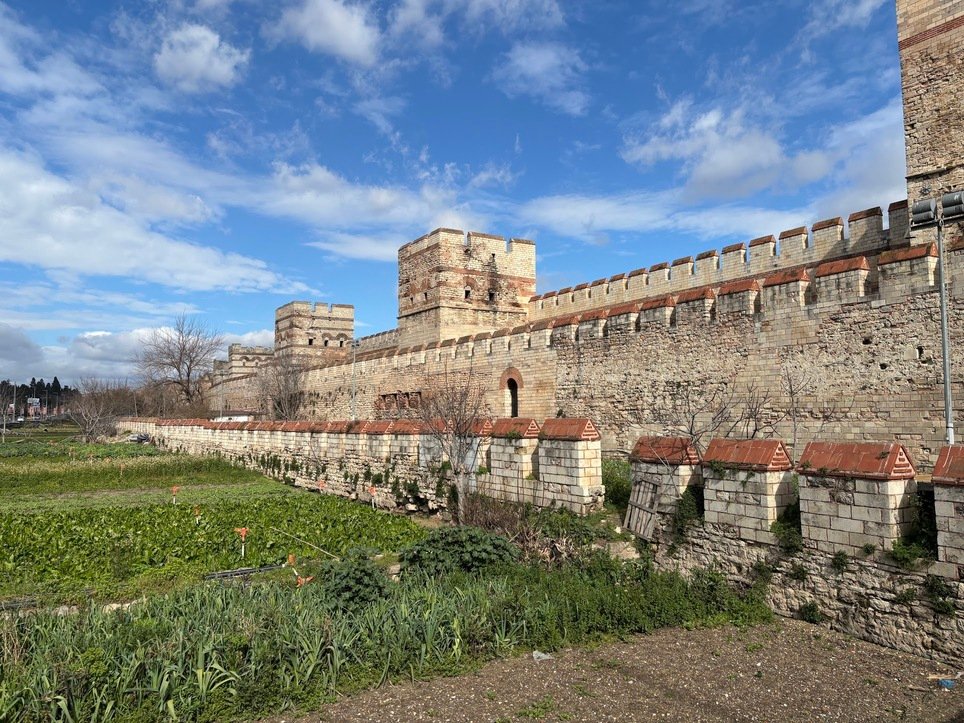
Between 408 and 413 CE, engineers constructed what would become the most advanced urban defensive system of antiquity.
The Triple-Layer Defense System
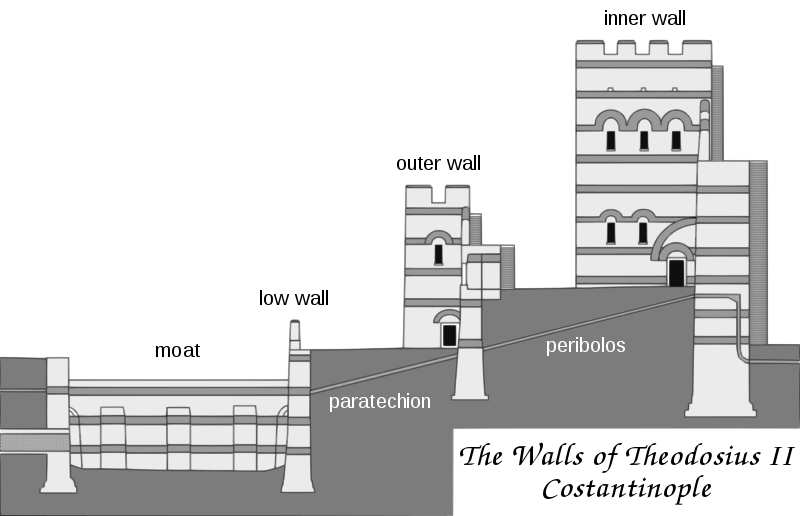
The Theodosian land walls were not one wall — they were a defensive machine.
1. The Moat
- Approximately 20 meters wide
- 7–10 meters deep
- Could be flooded using a controlled hydraulic system
Attackers first had to descend into and climb out of this ditch under missile fire.
2. The Outer Wall
- About 8–9 meters high
- Roughly 2 meters thick
- Supported by dozens of towers
This wall absorbed initial impact and slowed attackers.
3. The Inner Wall (Mega Teichos)
- 12–13 meters high
- 4.5–6 meters thick
- 96 massive towers
- Walkways and crenellations for archers and artillery
The masonry was a sophisticated combination of limestone blocks and horizontal brick bands — an earthquake-resistant technique that distributed structural stress.
This was Roman military engineering at its peak.
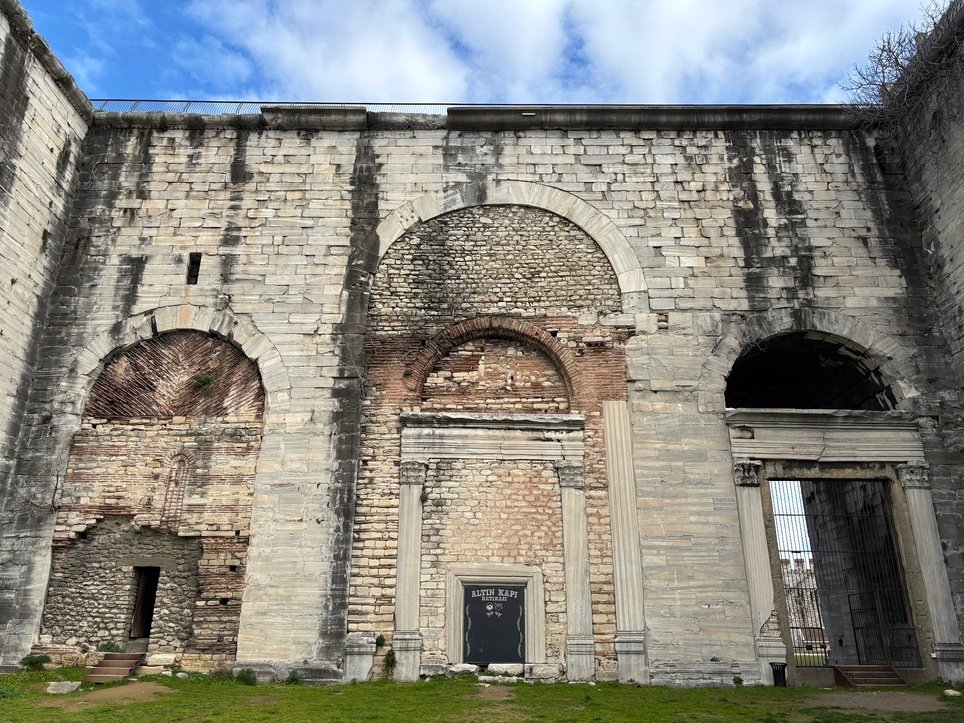
Architecture as Strategy
The walls were designed with layered tactical logic:
- Towers staggered for interlocking fields of fire
- Height dominance over attackers
- Terraced space (peribolos) between walls for troop movement
- Secure internal access to towers
- Monumental gates integrated into defense
One of the most famous entrances was the Golden Gate — a triumphal arch incorporated into the system and used for imperial ceremonial entries. The walls were not merely defensive; they were ideological. They projected permanence, order, and divine protection.
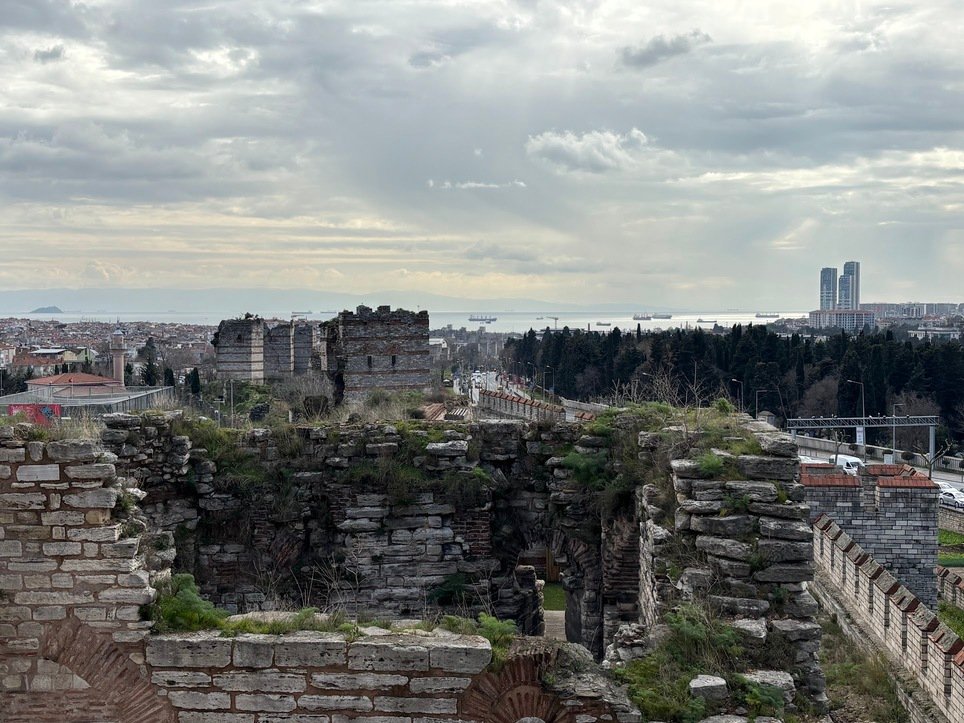
Why the Walls Worked
For over 800 years, no enemy successfully breached the Theodosian land walls.
They repelled:
- The Avars (626)
- Multiple Arab sieges (7th–8th centuries)
- The Bulgars
- Numerous medieval assaults
Even during the Fourth Crusade in 1204, attackers avoided the land walls and instead exploited weaker sea defenses. The land walls only fell in 1453 — after weeks of concentrated cannon bombardment under Mehmed II. Even then, artillery — not infantry — made the difference.
For over a millennium, Roman engineering held.
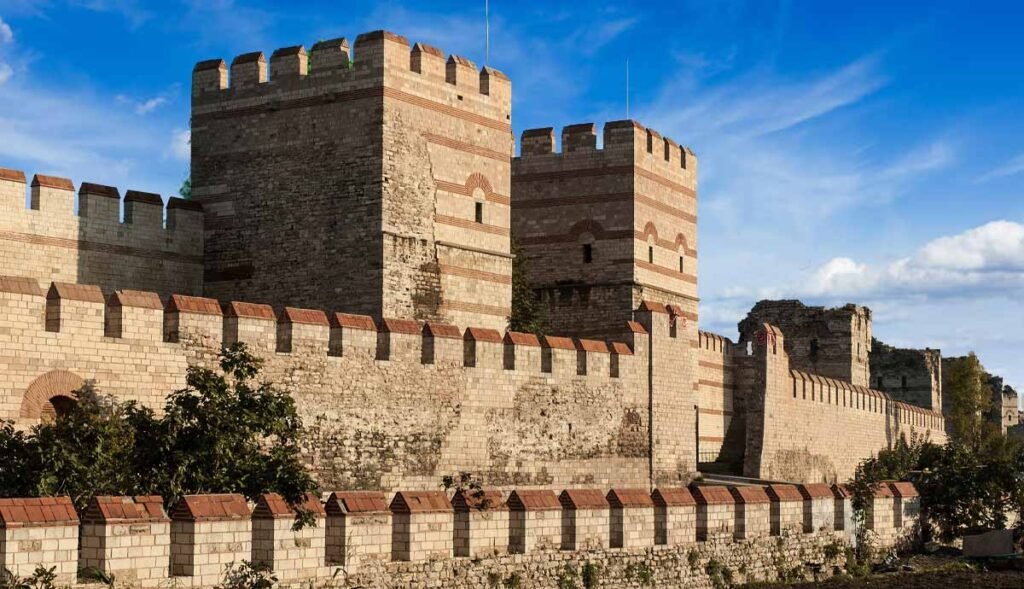
Urban Impact: The Walls Shaped the City
The Theodosian walls defined Constantinople’s western boundary for more than a thousand years. Everything inside them — Hagia Sophia, the Hippodrome, imperial palaces, forums — developed within this protected perimeter.
The walls:
- Encouraged dense urban growth
- Created strategic gate districts
- Controlled trade and military movement
- Defined the psychological boundary of the empire
They were not only barriers against enemies.
They were the physical edge of the Roman world.
The Roman Legacy in Modern Istanbul
Large sections of the Theodosian walls still stand today in Istanbul, especially along the western districts from Yedikule to Edirnekapı. Walking beside them is not simply sightseeing.
It is standing beside:
- The longest-used defensive system in European history
- The reason the Eastern Roman Empire survived when the West collapsed
- A monument to imperial urban planning
The Roman walls of Constantinople were more than stone.
They were strategy in architecture.
They were politics in masonry.
They were survival engineered.
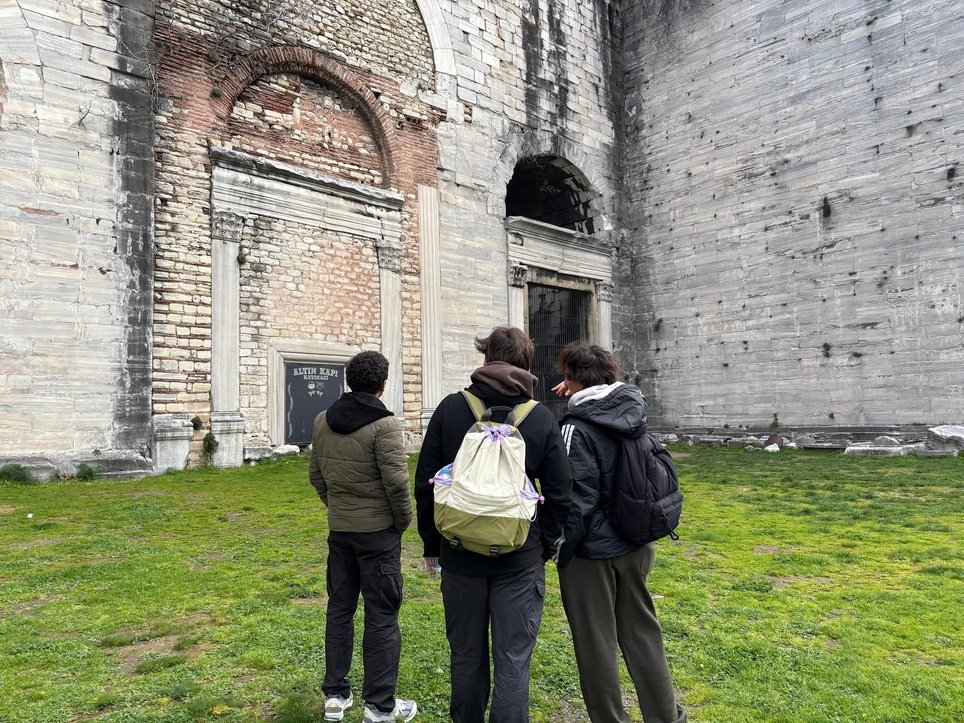
Walk the Roman Walls with Us
Explore the Walls of Constantinople from Yedikule Fortress to Edirnekapı and stand before the legendary Golden Gate.
Join us for a private, in-depth tour of Roman Constantinople — where engineering, strategy, and empire meet in stone.
Tagged with :